Showing posts with label recovery. Show all posts

Tuesday, January 1, 2019

A New Day is Dawning in 2019!


It's that time of year again. The very beginning. That moment filled with hope and anticipation, fresh starts and optimism. After eight years tolerating a steadily deteriorating left hip, I had mine swapped out in order to reset my system for the decade (or more) of endurance cycling ahead. The first big goal on my horizon is Paris-Brest-Paris in August and I have a nice, progressive schedule of brevets lined up to get me there starting on April 6.

While only time will tell, it seems like I may have timed my late October hip replacement surgery just perfectly. I've experienced steady gains over the past two months but just this week, I've been walking entirely pain-free and feeling stronger than ever. This has been such a welcome change following so many years feeling stiff, weak and sore. It's remarkable how much we can get used to over time and I don't think I fully realized how old all of this made me feel.

But today's a new day. After six weeks of physical therapy, I recently switched from working out on the recumbent trainer at the gym to using my own bike on the trusty Cyclops trainer at home. I'd been resisting the need to throw my leg over the top tube until I was a bit more flexible and steady, but the positive feeling of clipping into my own bike after so many weeks cannot be overstated.


I've been taking it slow and steady on the trainer, though, gradually adding higher levels of aerobic resistance here and there to build strength and a foundation for the more ambitious training I envision as the season progresses. I'm not in any real rush to get out on the roads this winter, but look forward to doing so once I develop more strength and stability on the bike. Perhaps a nice warm day in late January. In the meantime, I plan to ride for at least an hour a day, five or six days a week, while increasing my aerobic load and my duration each week. This may become a bit challenging as my travel schedule picks up, but that's what hotel gyms are for, right?

So for now, the operative words during this season of base training are patience and consistency.

Saturday, November 10, 2018

Recovery: Week Two


Week Two was filled with milestones. My gains have been pretty dramatic and super encouraging so far. During this week, I:

  • Said goodbye to all painkillers stronger than Tylenol,
  • Had all of my staples removed,
  • Packed up and sent the dreaded leg pump device back to the hospital,
  • Graduated from in-home PT to out-patient PT,
  • Started driving,
  • Voted, 
  • Attended a conference and made presentations both with and without my leg pumps, and
  • Met with my surgeon and received some really great news.

My mobility has increased and my pain has decreased at roughly the same rate. The simple exercises I've been doing several times a day have helped to strengthen my hip and leg muscles and improve my range of motion. The swelling has dropped dramatically and I no longer need pain medication stronger than Tylenol. A nurse came by on Thursday to remove all 42 of my stapes which left me feeling much better.


Also on Thursday, I met with my surgeon who confirmed that my surgery was smooth, my progress has been impressive and that I'm well on my way to recovery. He also told me about some very interesting discoveries he made about my body during surgery. While he knew that my femur was deteriorating, apparently my hip and leg muscles were doing all sorts of weird things to compensate. Much of the pain and stiffness I've been feeling since my 2010 crash, he suggested, may simply have been the result of adaptations my body was making to compensate for the fractures and displacements. In other words, the progress I made with walking and riding may actually have created additional problems and pains that ultimately caught up with me.

The great news is that this should all be fixable. While the doctor told me that my muscles were going to be "pretty unhappy" with me for the next few months, ultimately my body should regain proper alignment and I should be stronger than ever. Perhaps the best news, though, to come out of Week Two is that there are times when my hip feels much, much better than it has in a long, long time. While I feel some occasional discomfort, especially in my hip flexor when I stretch in certain directions, there are some pains I had gotten quite used to that seem to be gone for good.

Saturday, November 3, 2018

My Long-Term Recovery Begins Anew


I used to write a blog about my love of randonneuring and the many joys it brings me as well as the challenges and obstacles I face as a parent and a professional maintaining a sense of balance and harmony in my busy life. Well, looking back at the past year, it seems like I've been losing the battle. Two posts in 2018 . . . ugh!

This has been a hard year for sure. Most dramatic and upsetting was the decline and then death of my dear father-in-law whose long fight with cancer was both an inspiration and a frequent distraction. With family in need far away in New England, my wife and I spent many weekends on the road this year and rarely with a bicycle. All things considered, I would not have spent my time differently, but trying to maintain a training and event schedule in the face of constantly changing needs left my head spinning more than usual and led to the cancelation of multiple riding plans with only short rides on Block Island on many a weekend.


While I rode more than I blogged in 2018, my riding declined rather dramatically as well, not only due to conflicting obligations but also as the result of gradual physical changes I've been facing in recent months that made riding more challenging and less enjoyable than in years past. As I have discussed before, I was diagnosed with avascular necrosis in 2015, a byproduct of the 2010 crash in which I originally broke my hip (and 24 other bones) while riding in the Endless Mountains 1000K.


This year I was not able even to muster a simple super randonneur (SR) result despite the best-laid plans . . . In fact, all I completed was the Atlanta 200K, the Bash Bish 300K, the Portland-Boston 400K, a few 100Ks, and a solo Catskill Climbfest 200K. I had sketched out such a lovely season, which was to be capped off by the epic Cascade 1200K I've been dreaming about for so long, but life, as they say, had other plans for me.

While my performance on the bike has declined in recent years, the issue that really got my attention was the increasing pain I felt in my left hip at first following and then during long rides. Randonneurs are remarkably adaptable and so it took some time for me to realize that I had been shortening, slowing and flattening my rides to avoid pain for some time. Finally, I determined that enough was enough and met with my surgeon to make plans. The only cure for avascular necrosis is to remove and replace the dead tissue so I consulted my calendar and scheduled a total hip replacement for a date this fall that would allow me enough time to recover and train for PBP 2019.


I'm pleased to report that the operation went very smoothly and ten days later I'm already well on the road to recovery. There are some significant differences this time around. I was shocked by how easy it was to stand on my new hip, for instance, the pain not nearly as dramatic as it was the last time I had to work through rehabilitation. I took a week off from work to focus on my recovery and can already see a light at the end of the (not too dark) tunnel.  


My surgeon tells me that I should be riding on a stationary bike within a few weeks and then back out on the roads within three months. This timeline seems perfect for a solid return to randonneuring in 2019 capped off with a strong finish at PBP, which is my concrete long-term goal. I've got spring rides reserved on the calendar and plans for plenty of winter base riding, strength training, and interval work.

It feels like a fresh start. More to come. Stay tuned!


Tuesday, July 15, 2014

The Final Stage of Redemption: The Lap of the Lake 1000K


The Lap of the Lake 1000K brevet is the single longest ride I’ve attempted since my 2010 accident. It is an event that would test whether my physical repairs (specifically those in my shoulder and hip) would support my ability to ride hundreds of miles over multiple days. I have had this particular ride on my mind ever since I was unable to start after being sidelined (also in 2010) by a crash in which I broke my arm. As a result, this ride was about more than simply having a good time with friends new and old and seeking out adventure on an exciting and unique course. It was about confirming that I have the ability to successfully ride long brevets once again and, specifically, that I will be able to train for PBP 2015 with confidence.

Since I was unsure of my performance at this distance (especially since the LOL 1000K is run unsupported and offers no SAG support in the event of emergency) I thought it wise to team up with others. I was especially grateful that JB, a two-time LOL ancien, was interested in teaming up along with hearty randonneur Nigel G. Our plan was a simple one: we would ride for 300 miles on the first leg, 200 miles on the second and then finish with 125 miles on the final day. With a 7:00 pm start, this meant that we would also front-load our night riding by powering through the first night as well as the second day and that we would need to arrange hotel accommodations on both Thursday and Friday nights.


I would recommend this mileage pyramid to anyone seeking a successful way to divide a very long ride. By front-loading the event with big miles, one builds up a time cushion as well as a buffer against fatigue. One of the ways we handled the sleep deprivation that results from this approach was to take a few “micronaps” along the way. Once on the first night when Mike W. developed a flat tire, several of us spied a gazebo in the middle of town and laid down for a ten-minute snooze, which we all found to be strangely refreshing. We also grabbed a similar rest in a park in Kingston the following afternoon after eating our lunch at a fine little cafĂ©.

One of my least favorite sections of the route, due in part to my somewhat debilitating fear of heights, was the bridge crossing at the Thousand Islands. These bridges provide a spectacular view of the Thousand Islands region, but they also require cyclists to walk their bikes over two miles of vertiginous walkway with tractor trailers and cars speeding towards them at 60 miles an hour several feet away. As one nears the top of the bridge, the roadway literally bounces as heavy trucks power their way between Canada and the USA. Another low point of the route involved cycling through the sprawling suburbs of Toronto on roads that were both under construction and completely ill-suited to cycling. It is a blessed miracle that no one was hit by a car in this section and I hope the RBA seriously considers a rerouting to make for a safer and more pleasant way to navigate this major world city. While I’m a big fan of urban riding, suburban sprawl riding, where hostile drivers have no idea what to do with cyclists, is something no one should have to encounter, especially on a well-designed brevet.


My favorite sections of the route came before dawn on both Friday and Saturday mornings. On Friday, JB, Nigel, Gil L. and Mike B. and I clipped in around 2:15. It was a bit more chilly on Friday than it had been the night before, but I added my rain jacket and my new wool glove liners and felt more than adequately dressed to be comfortable in the cool morning air. It always seems to be a pleasant surprise to get back onto the bike after even the shortest of sleeps. As if by magic, the soreness and fatigue is gone and the excitement of starting a new day takes over on an emotional level. Several things made this particular section so remarkable. First, the roads were lumpy, curvy and rural, all of which added a mysterious quality that was accentuated by the full moon reflecting in the lake which popped into view on and off for the first 25 miles. Due to the amazing expanse of the lake, it appeared to my tired mind as if we were riding on a remote island rather than the shores of a massive lake and I almost thought I would see a goat cross the road as one might in Greece or some other romantic location.


The pre-dawn ride the next day between Niagara on the Lake and Niagara Falls was similarly magical. Nigel, JB and I clipped in around 3:30, this time to make it to the border control before it closed at 5:12 am. This deadline turned out to be a fantastic catalyst as we were compelled to ride through a glorious stretch of road bordered by regal estates with views of the Niagara River that were accentuated by the bright, full moon. Not long after leaving town, we stripped off a few layers to prepare to climb the escarpment, which was steep but not too terrible and magical in it’s own right. The Canadian government has maintained gorgeous parkland around Niagara Falls that makes the approach from the West very pleasant. Once we arrived on the top of the escarpment, it was not long before we entered the honky-tonk sections of Niagara Falls that cater to the tremendous volume of international tourists interested in catching site of this remarkable natural phenomenon. Our trip through town induced a bit of panic as the trail was not easy to navigate with signs hard to interpret and the clock ticking away. We very much did not want to break the border control and so were relieved when we entered the Rainbow Bridge in enough time to snap a few pictures and pass through the control at 5:10 am, two minutes before it closed. I’ve never before been the Lanterne Rouge at a control and the adrenalin rush associated with passing through just before the the control closed was not unpleasant.


Upon returning our passports safely to our bags, we pedaled over to the Denny’s in search of some coffee and breakfast. It was a joy to see Susan’s and Arthur’s smiling faces as they finished their meals and prepared for their next leg. We were not disappointed as the menu was perfectly aligned with our needs and I ordered a hot cup of strong coffee along with another plate of fried eggs, bacon, sausage and home fries. This was one of the many “real” meals we ate along the way, which is another strategy that requires an investment in time, but which pays great dividends with digestive comfort and energy management throughout the day. To hell with pocket food and liquid nutrition.


As with all long brevets, there were some times we were literally laughing out loud, and in this respect, “LOL” fully lived up to its name. One notable moment was our trek on day three across what appeared to be a post-apocalyptic highway along the southern coast of the lake. Not unlike the Palisades or Taconic Parkways in the Hudson Valley, this four-lane highway, complete with expansive green median was beautiful. The only thing missing was cars. We rode through the warm, dry and sunny afternoon as intrepid randonneurs might after a robot uprising has destroyed all other humans. When we spied an abandoned car in the shoulder, it caused more than momentary panic and fits of hysterics. Every so often, a lone car would zip down the road at 60 mph, but most of the time, the parkway was ours.


Another favorite feature of long brevets is the natural “hopscotching” that occurs when riders speed up and slow down and take breaks of varying lengths. As a result, I was able to enjoy the company of a wide range of riders over the course of our three days in the saddle. Mostly, I rode with JB and Nigel, with whom I had organized a strategy and reserved hotels to meet the demands of this unsupported ride. I was also able to meet and ride with an interesting assortment of riders of varying backgrounds and experiences that included: Gil L., a rider in his first season of randonneuring, Mike B., the president of DC Randonnuers, Steve Y., the RBA from Long Island Randonneurs, Calista, a quick rider from DC, Arthur from Toronto, Bob T., a strong rider from NJ with whom I have ridden before, Susan O., from Portland who (insanely) rode over 600 miles from Chicago to the start of LOL in what she lovingly refers to as her “Dumbass Tour” along with many others. It was also a real treat to be able to jump on the “Severna Park Peloton train” on day three as we made our way across the southern coast of Lake Ontario with a tailwind at our back and sun on our shoulders. With all of the hard work and motivation of this well-oiled machine, it was not difficult to keep a pace of over 20mph, which was a thrilling way to make up a bit of time across relatively flat terrain.


The penultimate control in Charlotte brought us to within 25 miles of the finish and afforded us some of the most spectacular frozen custard I have ever eaten. Since JB has been raving about this treat for as long as we’ve discussed this ride, I allowed him to buy me a “double” which we relished as we considered the final stretch. Having been separated from Nigel a bit earlier in the afternoon, we waited for him on the banks of the Lake and savored the rest before the final push to the end. When Nigel, Steve and Gil arrived with an appetite, they encouraged us to forge ahead and to meet them at the finish. With this encouragement, we clipped in and made the final approach. 


It was Susan who first introduced me to the term “full value” riding to describe her pattern of riding towards the back of the pack on a brevet and planning stops strategically and efficiently to allow for a comfortable and manageable pace on the route. This was, honestly, my first experience with full value riding as I typically spend my time in the first third of the pack. Having now spent time at all parts of the field over the course of my randonneuring career from first finisher to last man through the control, I can honestly say that I think the latter has the potential, especially in fine weather with a good group of riders, to be a whole lot of fun. I guess I have been thinking that folks at the very back of the pack were somehow suffering. This certainly was not the case with this event. We were having a blast sucking every bit of value out of this brevet. Thanks, Susan, for introducing me to this helpful way of looking at things.


All told, the LOL 1000K was an amazing event. Not only was it a brevet filled with unique natural wonders and amazing weather, but it was also an opportunity to ride with and learn from some awesome randonneurs. The Lap of the Lake 1000K was most remarkable to me personally, though, because it proved to me that my body is ready to take on PBP and any other 1200K in the wake of my terrible accident. It allowed me to discover that I was not permanently and irreparably damaged. While I may never be quite as fast as I was before the crash, I am confident that I will be able to take on whatever cycling challenges come before me. None of the pain I felt at the finish of LOL was in any way related to injuries I sustained in 2010. My shoulder gave me no trouble and neither did my hip. It was only the pedestrian pains of palm and knee that caused me to pop ibuprofen tablets on day three. In other words, I’m back, baby, I'm back!

Sunday, March 2, 2014

Two Randonneurs Suffer in Hit and Run Accident on 200K Permanent - Please Share.


I write today with a a heavy heart about two fellow randonneurs who were tragically struck while riding a 200K permanent in Maryland last week. To makes matters worse, the assailant abandoned the riders to die on the side of the road at the site of the crash. Fortunately, emergency crews were notified and both riders were taken directly to hospitals for treatment, one by ambulance and the other by helicopter.

The investigating police department was quick to post the notice above on Facebook, which you should read and share if you have not done so already, especially if you live in the Washington DC area. While unlikely to bring the perpetrator to justice, there's always hope that someone out there may be able to connect the dots. Here is a link to a full article in The Washington Post with additional details.

Gauging from the story and from photographs posted online, the accident occurred at what appears to be a fairly common location, a bridge where the road narrows and the shoulder disappears. We've all been there before. There are steps to take, but no manner of reflective gear, lighting, hand signals and "taking the lane" will fully protect you from the negligence of a driver of a two-ton SUV.

This accident certainly stirs memories for me as I recall the long, painful road to recovery after my own particular run-in with a car. In my case, though, I was fortunate that the driver of the car that hit me did not leave the scene and took full responsibility for his actions. As a result, the medical team came to my aid quickly and his auto insurance company delivered on their commitments to my care.

Please join me in sharing the news of this terrible accident and in offering support to the victims and others who suffer from similar tragedies. I hope that our two sisters in randonnering will recover quickly and completely from this terrible crash and that they and their families get the support they need along the way.

Beyond this particular crisis, we all need to engage in whatever it takes to reduce the incidence of vehicular cycling accidents. Ride your bicycle often. Call your representative. Write a letter to your local paper. Riders of bicycles have just as much a right to use our nation's roads as do drivers of automobiles. We will not live in a civilized society until everyone acknowledges this simple fact.

Sunday, December 29, 2013

The Festive 500: Recovery Ride to Slabsides


While Gilded Age robber barons were erecting massive estates along the Hudson River and throwing parties that cost more than most people earned in a year, a quiet man named John Burroughs (who also built a lovely home on the west side of the Hudson) snuck up to this rustic cabin and wrote some of the most influential works on environmentalism to date. I could not think of a better site to visit on my recovery day than Slabsides, which sits high on a rocky outcrop about a mile from my own house. Burroughs is not very well known these days, but he was one of the most highly regarded writers of his generation. His influence on others such as John Muir and Theodore Roosevelt was significant. Legend has it that TR sailed the official presidential yacht up the Hudson and walked up the hill to meet Burroughs at this cabin, irritating Frederick Vanderbilt right across the river to no end.


Today's recovery ride reminded me of that wonderful feeling that comes from riding too far. After several months in which I rode about 100 miles per week, five days filled with 270 miles creates a feeling that is both pleasing and hard to describe. Onward ho!

Sunday, June 10, 2012

The Sweet Feeling of Success


It feels especially sweet to reach goals that are both challenging and long standing. I've wanted to earn the RUSA R-12 Award for many years, but the cold Northeast winters and countless compromises I would have had to make kept this out of reach; out of reach until this year. This weekend marked my final monthly ride of over 200K since last July. It also marks a year of riding brevets since returning to cycling after my August 2010 accident. In addition to the R-12 credit, this brevet also proved to me that 400K is still within my reach as a cyclist. I finished tired, a little sore in my left shoulder, but strong and within 20 hours.


The field was tiny on this late season 400K. There were just six of us, two from North Carolina, one from Cleveland and two from the local area in addition to me. The first six hours of the ride were filled with steady rain which calmed into showers and then petered out all together leaving us with a beautiful afternoon.


Shortly after the start, I fell into riding with Jonathan, a strong rider from Cleveland with a beautiful new Velo Orange rando bike, who really helped me stay focussed throughout the day. Jon is a great guy and I look forward to riding with him again. It reminds me how randonneuring can unite total strangers in a shared mission. Maybe it was the rain, maybe the green hills and valleys throughout the day, maybe it was the smell of fresh cow manure, but something about this ride reminded me of London-Edinburgh-London.


It was a spectacular ride set in the beautiful Finger Lakes region. The vistas were amazing and the roads smooth and free of cars. I will surely be back for more rides in Central New York and highly recommend them to you. I could actually hear Lake Ontario beckoning for circumnavigation as I stood on it's banks at the start of yesterday's 400K. Perhaps the Lap of the Lake 1000K lies ahead. I sure hope so.

Next up: the Westfield 600K on June 23-24.


Monday, May 14, 2012

The Princeton 300K: A Little Confidence Grows with Each Ride.


The Princeton 300 is the longest ride I've attempted since my August 2010 accident. It's an old favorite that takes in large stretches of the New Jersey countryside I prowled in my younger days. The Princeton 300 is also the first event of that distance I ever completed in 2007 during my first year of randonneuring. The weather forecast could not have been better on Saturday with blue skies, still air and temperatures peaking only in the mid-70s. For these reasons and more, it was a perfect day to stage my return. 


We rolled out of Princeton before dawn and traveled north over smooth, barren roads to the first control in Whitehouse just a few miles away from my mother's home where I had awakened several hours earlier. Throughout this first 40 or so miles, I rode at the front of the pack with a few old riding buddies swapping the usual tales of rides past and future and bikes custom and vintage.


After the first control, the field spread out a bit and, while I was disappointed not to hang with the big dogs, I knew that maintaining my reserves was the only way to approach this day. Riding strong throughout the event and simply finishing the ride with some gas in the tank would bring me great relief. With over 9,000 ft of climbing, this is not a ride to take casually. Although it was hard to let the rabbits go, I knew this was the wise choice.


Support on NJ Rando events is fantastic and this brevet was no exception. Ride organizer Paul S. was cheery at the start and and finish and made countless appearances at controls, both secret and announced, throughout the day. NJ Rando stalwart Bob O. was on hand at both the start and the first control and it was great seeing RBA Katie R. and diehard NJ Rando volunteer Jon L. at the Blairstown control. Their smiling faces mitigated any pain and suffering I may have been feeling as I contemplated the nasty Jenny Jump climb that punctuates the turnaround.


Attuned to my own rhythms, I spent much of the day riding alone which eliminated the need to feel as though I was either holding someone back or riding slower than I would like.  In all, I felt fairly steady, if not truly strong, throughout the day and finished without any noticable pain, despite the requisite suffering.


They say you can't go home again, and I do believe that's true, but just as I was rounding the corner to enter Hacklebarney State Park, I ran into an old friend I haven't seen in quite some time. John R. is the master teacher I worked with 25 years ago as a teaching intern fresh out of college. While we've seen each other since that time, it's been a while and it was good to catch up and see yet another encouraging face when his wife Barbara arrived to pick him up.


With the main work of basic recovery behind me, I'm on my way to rebuilding an endurance foundation. Completing a full brevet series in search of the Super Randonneur (SR) award issued in Paris to recognize riders who completion a full series of qualifying brevets (200K, 300K, 400K and 600K) in one season will make that return even more sweet. This weekend's Princeton 300 also served as the penultimate ride in support of my R-12 attempt. Only June remains.

Thursday, January 12, 2012

My Story Published in American Randonneur (Winter 2012)

I was honored to have my reflections on my accident and subsequent recovery included in the Winter 2012 issue of American Randonneur. While much of the article was adapted from writing that appeared first on this blog, here is the article in its entirety.


As I look up into the bright lights, I realize that I’m definitely not still riding my bicycle. The fact that I cannot remember anything about my crash is probably a significant factor in my ability to ride again. I have no creepy feelings when I ride; I don’t look over my shoulder with dread every time I hear a car roll up beside me. While I’m told I was conscious and able to communicate with the paramedics on the side of the road for at least a few minutes, I have no memory before looking up into those lights. I don’t know whether I was in the ambulance or the hospital at that point.

The first thing I said when RBA Tom Rosenbauer handed me his cell phone to speak with my wife was “oh no, she is going to be so worried.” It didn’t occur to me that she was already pretty worried after being awakened by a 6:30 am call as the words “Hospital . . .Pennsylvania” flashed across the caller ID on the bedside phone. “Yes, there’s been a serious accident,” the voice said, “no, we can’t tell you how he is. You’d better get down here to the hospital as soon as you can. We need to operate.” My wife describes an eerie calm as she woke our two children and called her parents to arrange for the three-hour ride to the hospital.

I rode my first SR series in 2007, but was unable to finagle a trip to Paris that year, so PBP has been on my mind ever since. Riding in the 2009 edition of London-Edinburgh-London further whet my appetite for international rando-adventure and I was riding the Endless Mountains 1000K, in part, to ensure priority pre-registration for PBP 2011. At 4:00 am on August 26, 2010, about 25 riders and I rolled through the dark hilly countryside of Eastern Pennsylvania. At 5:45, I was fully awake and rolling along with the rhythm of the front pack of riders as the sun was just beginning to peek its head over the horizon. As a responsible randonneur, I was lit up like a Christmas tree, but this did not deter a young, distracted driver from gliding into the shoulder and taking me out like a bowling pin. My custom-made Independent Fabrication was totaled. I have no memory of the accident.

Fortunately, my bad luck ended when I was hit. I was rushed by ambulance to St. Luke’s Hospital in Bethlehem, PA where both my legs were operated on within a few hours of the accident to repair my broken right femur and left femoral neck. Two days later, I underwent another surgery to repair a badly broken left clavicle. All in all, I broke 24 bones – none of which was set with a cast. I now have a titanium rod the length of my femur permanently implanted in my right leg. I also have a bunch of screws and a plate holding my left femoral neck and clavicle in the right places. In addition to the breaks that needed surgical repair, I fractured my right scapula, ten ribs, five vertabrae, three hip bones and more things with names I can’t recall. Remarkably, I did not sustain any significant internal injuries, spinal damage or head trauma. There was not even a patch of road rash anywhere on my body. My wife Jessie never left my side and slept in a small foldout chair typically reserved for nervous spouses awaiting the birth of a new child.

With Ron Anderson and Laurent Chambard at St. Luke's Hospital (August 2010)

After two weeks at St. Luke’s, I was transferred to the Helen Hayes Hospital in Haverstraw, NY, which sits atop a hill overlooking the Hudson River about one hour downstream from my home. At Helen Hayes, I lived and worked on the spinal injury floor, not because I injured my spine, but rather because I had similar rehab needs with only one of four limbs able to bear weight. I spent several hours each day in physical and occupational therapy and was able to get around with the help of a motorized wheelchair and spent the time not in therapy outdoors reading in the warm fall sun and connecting with friends, family and acquaintances through social networking sites, which gave me a small window into the power of technology to connect and transform the lives of those with physical challenges.

Luckily, my randonneuring experience came in handy during my recovery. Patience and the ability to endure uncomfortable and fairly unpleasant sensations for an extended period of time is useful during rehab. After four weeks at Helen Hayes and six weeks from the date of my accident, I was released on Columbus Day weekend and finally had the chance to drive home with my wife. I had to swap the time normally spent training and commuting by bike with physical therapy sessions, trips to the gym and stretching. I was directed to stay home to recover more fully and returned to work on a part-time basis in early November.

In November, I met with a shoulder specialist to review the results of a full series of scans and tests to find that her initial suspicions about why my shoulder was lagging were correct. It turns out that I was suffering from the effects of a previously undetected, displaced humerus fracture which involved a piece of bone and the associated rotator cuff muscles swimming around in my shoulder unattached. So my 24 broken bones had now grown to 25. No wonder I couldn’t raise my arm. The only solution was surgical and the likelihood of repair hovered around 50%. I was clear with the doctor that the most important outcome was getting my left arm to "handlebar height;" anything else was extra. In December, I went in for my fourth surgery and after a brief period of rest, the winter and spring were subsumed with shoulder rehab and the quest to build greater stability and strength in my legs.

My return to the road came in late March, after being given permission from both my general orthopedist and my shoulder surgeon. While I thought in the weeks after the accident that I would be able to ride PBP in 2011, I soon realized that the pace of recovery would be much slower than I originally dreamed. When I realized that I could not participate in this year’s edition of PBP, I knew that it would be important to replace it with another epic event to mark my return to riding and to use as a goal in my recovery and training. The famed Deerfield Dirt Road Randonee (D2R2) was just the ticket. At 180K, it was not the distance that makes the ride epic, but rather the 180 kilometers of largely dirt carriage roads that snake their way through the mountains of Western Massachusetts and Southern Vermont.

Climbing Perkins Hill on the NYC 200K (July 2011)

In June, I was riding and reaching my handlebars comfortably enough to justify meeting with Paul Levine of Signature Cycles, the fit expert who put me on my first custom bike. The fitting revealed that I didn’t need any specialized accommodations on the new frame and we put the order through. That month, I also rode in my first events since the accident - a local 50-mile ride followed a few weeks later by an organized century. My return to randonneuring came in July as I rode the NYC 200K, which was both physically and emotionally fulfilling. In August, exactly one year and one day after my accident, I completed D2R2, which was one of the most demanding days of cycling I’ve ever experienced. August also included a local 200K permanent and another in September to lay the groundwork for the R-12, which is a goal that’s eluded me for some time.

So where am I now, almost 14 months after the accident? I still love riding and continue to hope for a full recovery as a randonneur. I’ve yet to tackle distances greater than 200K, but will do so after a bit more training. More importantly, though, I feel like I’m approaching riding with a new mindset. I find myself closer to family than ever and have an even greater appreciation of the need for balance between riding and the other parts of my life. I realize that I’m married to an absolute saint. I’m thankful to everyone who reached out, sent an encouraging email, visited me in the hospital, posted a comment to my blog, prepared dinner for my family or was generally patient with me during my long period of recovery.

After a full year of recovery, I no longer feel like a patient. I’m living without chronic pain and moving around almost like I did before the accident. My hip just received a clean bill of health; it turns out that I do not suffer from avascular necrosis unlike 30% of those with similar breaks so there is no hip replacement in my immediate future. My shoulder mobility is still a bit asymmetrical, but I have a full cycling range and feel comfortable and safe on my bike. So what’s next? Randonnuering, like the rest of life, is about making choices. In addition to the R-12, I plan to ride a full SR series and perhaps a domestic 1200K. My white whale, though, remains PBP. While it may be a long way off, this is my true goal. I just ordered a set of personalized license plates that read “PBP 2015.” Join me. It should one hell of a ride.

Friday, December 30, 2011

The Rapha Festive 500 Round-up


If 2011 was my year of RECOVERY, 2012 will be my year of REDEMPTION. This is why ushering in the new year with Rapha's Festive 500 was so important.  A "Ride to Redemption" it was. As readers of this blog know in somewhat excruciating detail (move on already, they yell!), I suffered a catastrophic accident in August 2010 when a distracted driver hit me from behind on the Endless Mountains 1000K brevet I was using to train for Paris-Brest-Paris. After breaking 25 bones (including both legs), spending 6 weeks in the hospital and 18 months in physical therapy, I am ready to move on.  The Festive 500 could not have come at a better time. 500K represents my greatest weekly volume of riding since the accident and bodes well for the year ahead.

When I read about the challenge last week while perusing the Rapha website, I was not entirely sure I could pull it off. As a randonneur and ultra racer, I've ridden 500K in 24 hours on several occasions and 500K in a week many times, but that was all before the accident. What would the impact of this level of concentrated riding be on my system NOW? Would my legs hold up? Would my shoulder give out? Would I develop fatigue in my hips? While I've been riding at least one 200K event each month since July, I would not know the answers to these questions until I tried.

All told, riding 500K in a week was a piece of cake. The most difficulty came from squeezing time on the bike in between family plans, as is usually the case rather than any physical demands per se. The weather even generally cooperated with warmer and drier conditions than normally prevail in late December.

Here is a collection of blog posts chronicling each of my Festive 500 rides:

Day 1 (75K)
Day 2 (69K)
Day 3 (31K)
Day 4 (20K)
Day 5 (52K)
Day 6 (54K)
Day 7 (202K)

So repeat after me: "the word of 2012 is Redemption."

Saturday, December 3, 2011

Knowing When to Stop: The Endurance Athlete's Achilles' Heel


Knowing when to stop is not easy for athletes and it can be a serious liability for endurance athletes in particular. If it weren't for a virus my wife picked up, I'd be riding a 200K permanent today. Riding despite some pretty significant pain and mobility reduction in my left shoulder as a result of some yoga and leaf raking I did last weekend. Any sensible person would say, "time to take a week or two off until I'm feeling back to normal," but randonneurs aren't normal. What generally makes randonneurs, and ultra-distance athletes in general, successful is the ability to look adversity, pain and discomfort in the face and say, "to hell with it."

My wife tells a funny story she heard from her doctor about a guy who broke is toe running, yet persisted in asking the doctor what he could expect from continuing to train despite being told to take a six-week hiatus to heal. He was relentless. The only trouble is, I can see the runner's point of view all too clearly. The temperament that leads to our success can also be our undoing.

I was actually very impressed with Diana Nyad's recent decision to end her "Extreme Dream" to swim 103 miles from Cuba to Florida after being stung repeatedly by jellyfish and looking at the possibility of DYING from shock if she continued. DNF and DNS particularly nasty expressions to use with an endurance athlete, but sometimes saying no is the best thing in the long run.


So with 27 days left in the month (14 of which I'm actually on vacation), I'm not too nervous about the impact that this day off will have on my R-12 plans, despite the fact that it will undoubtedly be colder and perhaps even snowy when I'm feeling up for my next 200K. Hopefully, though, I'll have enough willpower to wait until my shoulder has healed a bit more from this setback before heading out on a day-long ride.

Wednesday, November 2, 2011

My Favorite Award of the Year


When a package arrived yesterday afternoon, I had no idea that it would contain the final chapter of a brevet I began on August 26, 2010. As everyone will attest, Eastern PA RBA Tom R. is a straight-up guy. He puts on a huge array of outstanding events, is highly organized and has a heart as big as the whole outdoors. Tom is also known for providing solid support on his events. What people may not know, though, is that Tom's support is not limited to those currently riding on one of his routes. All throughout my long recovery from a crash on his Endless Mountains 1000K last year, Tom never stopped providing support to me or to my family.

Riders who completed the EM 1000K received a lovely framed map of the course in which to display their ACP medal. While I did not receive an ACP medal due to my DNF, Tom was kind enough to send me the framed map as a memento of my ride and my struggle to return to full form.

This gift is especially timely as I will clip in on Saturday morning at Tom's Stillwater 200K in a return to PA cycling after a long time away. This event will also serve as my November R-12 ride. The forecast is for outstanding weather. I look forward to seeing Tom at the final control, this time with a completed brevet card.

Tuesday, September 27, 2011

A Clean Bill of Health


Today my orthopedist examined my hip to determine whether I have any signs of the avascular necrosis (bone death) that develops in 30% of femoral neck fractures when blood flow doesn't adequately reach the ball of the femur. Avascular necrosis strikes within two years of an initial fracture and results in the need for a total hip replacement. So, I'm displaying no symptoms, feeling great and emerge from the visit with a clean bill of health. The doctor doesn't want to see me again. We're leaving the screws in, we're leaving the rods in, I have no more surgeries on the horizon.

I can't tell you how relieved I am to know that a total hip replacement is not in my immediate future! With no physical restrictions and no need for physical therapy, it's time to train and rebuild my strength, endurance and flexibility like an athlete and not like a patient.

Monday, August 1, 2011

The NYC 200K: Back in the saddle again!


The view from my saddle atop Bear Mountain.

The NYC 200K will always be one of my favorite events. Not only is the route lovely, but it's also the site of the first brevet I ever rode in 2007. It's also meaningful because the route connects the two places I've lived as an adult: New York City and the Hudson Valley. From now on, there will be a third reason I love this ride: eleven months and five days after being being hit by a car on the PA 1000K, I am finally back to randonneuring after successfully completing this event one more time.

I live close enough to the start that it makes sense for me to drive down the day of an event rather than stay over at a friend's or family member's apartment. On Sunday morning, I felt the familiar fog of awakening at 4:30 am to make some coffee, shovel in a bowl of cereal and head out into the darkness with a car filled with my bike and a few bags of provisions. The drive down was pleasant as I listened to Death Cab for Cutie at high volumes and a podcast of "Wait,Wait Don't Tell Me" at not such high volumes. Just north of the George Washington Bridge, I stopped into the parking lot at filling station to change into my cycling kit and insert my contacts before making the final crossing into NYC. After scrambling around in search of a parking place within a few blocks of the George Washington Bridge for more time than I care to admit, I made it to the start just in time to hear organizer Jonathan L. deliver pre-ride instructions. After receiving a few hugs from friends eager to see me able to ride again, I grabbed my brevet card and cue sheet and was off!

The start was invigorating and I found instant power in my legs as I charged across the GWB with other members of our group. It was great to catch up with Bob and Chris in this early stage, as neither would ride at my pace in the miles to come. In this first section, I also met up with Shane, Steve, Yiping, Robin and Lenny with whom I would ride for much of the first 90 miles. Sadly, at about mile 15 I realized that I had left my Hammer Gel flask and Endurolyte canister sitting in a bag in the car so my refueling strategy was in need of revision. After a pleasant ride along the Hudson River through Piermont and Nyack, we rolled into the first controle where I refilled my bottles and bought a granola bar for later. Not long after the controle, we entered Bear Mountain State park and began the five mile climb to the top of Perkin's Drive. I won't say I flew up the climb, but I was very pleased that I was able to make it to the top without getting out of the saddle which is my preferred way to climb. I guess my quads aren't in such bad shape after all.

The trip following the climb through Harriman State Park is lovely, but after passing a sign that reads "Rough Road Ahead" I realize that the park authorities have just about given up on repairing what turned out to be a frighteningly rough patch of road. The vibrations and jerkiness of this section really left me ragged and dreaming of fat low pressure tires which would have buffered the blow somewhat. We rolled into the next controle around lunchtime, but I was not very hungry so opted for fresh water, a pack of Endurolytes from Leroy and a bit more sunscreen for the ride ahead.

I took off from the turnaround countrole after just a few minutes and soon found myself riding with Lenny who regaled me with stories of his recent PAC Tour along the Eastern section of Route 66. After a while, Lenny stopped for a bit to eat and I pedaled on feeling more like the tortoise than the hare. After leaving Lenny to eat his lunch, I settled into a comfortable pace and rode the remaining 40 miles alone. This proved to be an especially enjoyable way to ride the final section without concern that I was either holding someone back or egging someone on. In the final stage, I was very pleased to see that the route has benefited from a very desirable revision which made it even more enjoyable this time around. The final stretch from Harriman State Park to NYC has been reworked so that riders avoid 9W all together and take in some beautiful, low traffic roads that differ almost completely from the roads used in the first half of the day.

Looking back on the day, the ride felt a bit like an Oreo cookie to me - soft in the middle but strong at both ends. While my physical condition is nothing like it once was, I was pleased by my overall performance on my first day back to randonneuring. It was difficult to watch folks I typically ride with take off ahead of me, but I knew this would be a more casual ride than I'm used to. Despite my lower level of fitness and lack of time on the bike, I was still able to finish in 10:06 at a respectable 9th position out of 40 riders. While not feeling particularly competitive, this top 25% finish left me feeling even more confident about my return to randonneuring. It was great to catch up with old friends and meet a few new ones along the way. Hats off to the organizers and NJ Randonneurs generally for all they do to put on such fine events. I can't wait until September for another shot at one.

Sunday, May 1, 2011

When DNS = Definitely Not Stupid.


DNS (Did Not Start). These three letters are only marginally better than the dreaded DNF (Did Not Finish). It's an absolutely perfect day for a spring ride and yet, with 32,000 riders feeling like they just won the lottery in NYC, I sit here in my living room. Why? Well, after a steady climb towards greater pain-free shoulder mobility, I began to feel pronounced nerve pain shooting down my left arm this past week. It's not steady or unbearable, but it is concerning and limits my range of motion. I've had to back off my physical therapy exercises a bit and hope it's not something I've caused through overuse. On Monday, I logged my longest ride to date with 24 miles. Old George would have simply thrown the bikes into the car today and said "screw it, I'm sure the pain will work itself out." New George, on the other hand, is more concerned with long-term progress, so while I'm very disappointed to miss this year's Five Boro Bike Tour with my son, I hope this temporary disappointment leads to better healing and recovery. So instead of 42 thrilling miles with sun and wind in my hair, I'm off to the gym for some sweaty stationary miles and a little lifting. I realize now that sometimes, DNS means definitely not stupid. Onward ho!

Saturday, April 23, 2011

The red efts are back and so am I.


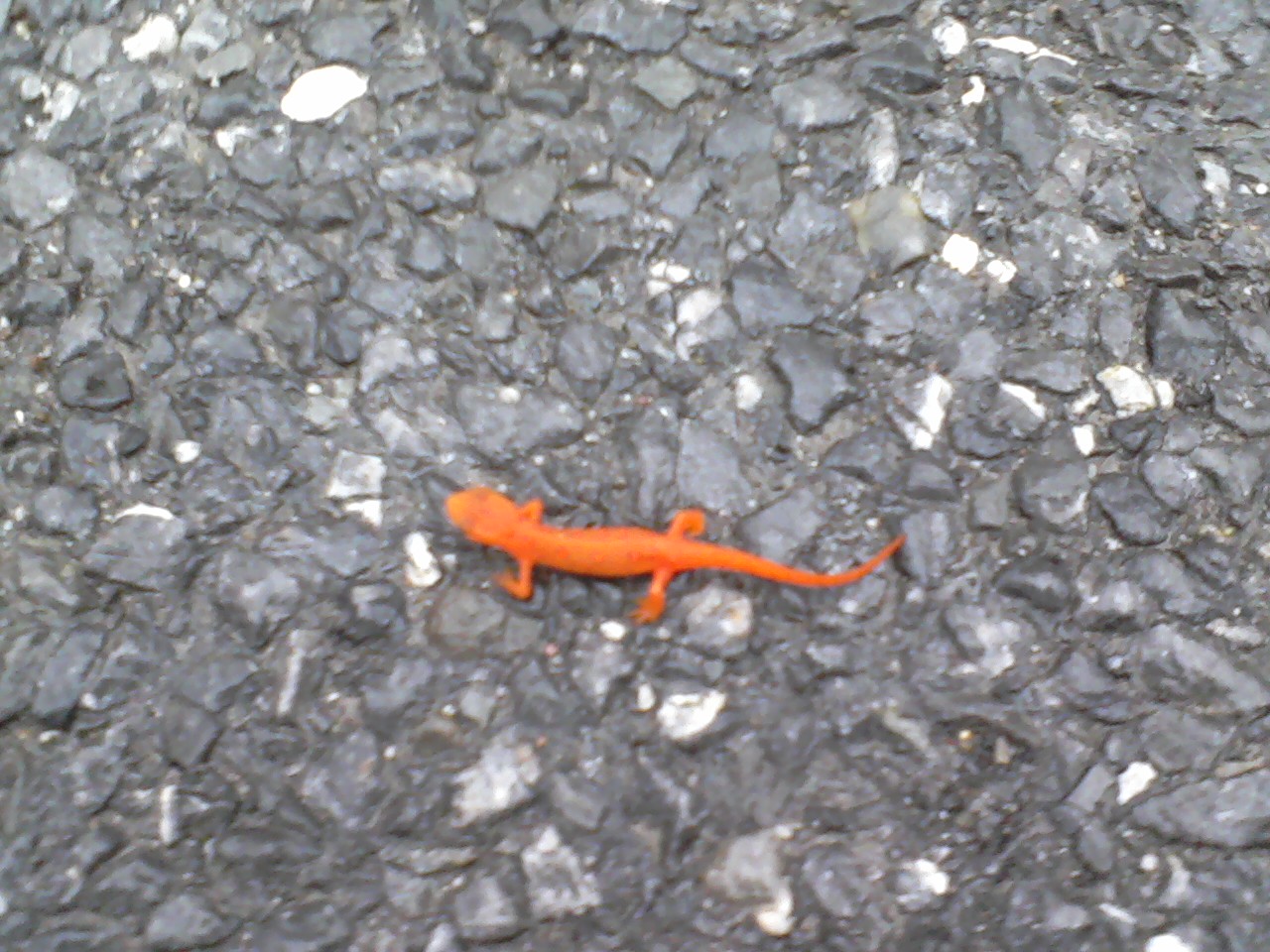
I went for a quick spin tonight on the quiet back roads behind my house. The roads were so quiet, in fact, that I only saw one car in just over an hour of riding. I did see this little feller crossing the road, though, and he reminded me of all the subtle natural beauty I see while riding that people who spend their time in cars totally miss. Spring is a glorious time in the Hudson Valley. After a long period of monochromatic living, we are again blessed with the slow, but steady, reintroduction of color into our lives. Yellow forsythia, purple crocuses, pink magnolia all dot the greening landscape and remind me of the glory of rebirth.

Today was the first brevet of the season on my original 2011 event calendar. I had hoped to ride the beautiful Princeton 200K again this year as a season opener, but my post-surgery healing has taken a bit longer than I had naively expected back in December. While I made sure to ride today anyway, I am in no shape to complete a 200K at the moment. That said, every ride I take feels better than the one before and today was no exception. I feel increasingly steady and comfortable on the bike and find myself forgetting that I'm actually healing from a serous injury.

My revised first event of the season is coming right up, though. Next Sunday, my son and I will enjoy our third Five Boro Bike Tour together. I'm ready and can not wait to spend 42 miles pedaling at my son's side. Two years ago we endured monsoon rains and last year we both got sun burns. Maybe this year it'll snow.

Thursday, April 21, 2011

Do you still ride without a Road ID? I don't.


Do you still ride or run without a Road ID? I don't. Mine just arrived this week and it looks a lot like this one, except it has my name and contact information on it instead of Jamie Johnson's. That seemed to make the most sense.

I never thought I'd be lying on the side of the road unconscious or otherwise unable to direct medical help after a crash. That is until this past summer when I was hit from behind by a distracted driver. One minute I was riding along, an experienced randonneur on a 1000K brevet, and the next minute I was in a hospital emergency room about to undergo surgery to repair several of the 25 bones I had broken. How did I get there? I certainly was of no help. Luckily another rider happened upon me and let the rescue workers know I was connected to an organized event.

While my wife finds the Road ID to be a grim reminder that I engage in life-threatening fun, we're both more comfortable knowing that if anything does ever happen, I'll get the best help possible. For less that $20, it seems well worth the peace of mind. In addition to my contact information, I added one last line to help me focus on the future. It reads: "Randonneur - PBP 2015."

Wednesday, April 20, 2011

Tragedy, loss and recovery in "The Long Run"


And I thought I had it bad! There's nothing more humbling than reading a story about someone who's had a far more serious accident and grueling recovery. In The Long Run, NYC firefighter, bar owner and endurance athlete, Matt Long describes how a terrible bike accident in 2005 cut short his plans to run the Boston Marathon, but did not stop him from fighting his way back to run again. I should explain from the start that I'm a sucker for tragic-adventure memoirs. Into Thin Air, Between a Rock and a Hard Place and Off the Wall sit prominently on my book shelf and films like "Grizzly Man" and "Into the Wild" are listed among my Netflix favorites. That said, I did not love this book.

Matt's story is surely an inspirational one. Pinned beneath a 40-ton bus while commuting to work on his bike in mid-town Manhattan, Long was impaled by his seat post and lost a tremendous amount of blood while severely damaging several vital organs and destroying quite a few important bones and muscles. It is nothing short of amazing that he is now able to run again after 40 surgeries and years of rehabilitation. Co-written with a professional writer, it is still far too rambling a tale. His editor should have taken a more aggressive surgical approach. Long's story of recovery includes far too much reflection on his macho life as a firefighter and not enough detail on his incredible rehabilitation for my taste. As a result, readers are not able to fully appreciate and savor all that Matt has gone through in his remarkable journey.

My reading of this book is admittedly idiosyncratic. Like Matt, I was hit by a car while cycling and have spent a great deal of time in hospitals and physical therapy unsure that I would ever be able to become the athlete I once was. While my injuries were nowhere near as severe as Matt's, his book leaves me hungry for details about the healing and recovery process. Unfortunately, Matt neglects to devote any time at all to some of the sad realities of what takes up much of a recovering athletes time after a serious injury. Where are the countless hours spent arguing with insurance companies over bills that keep piling up? How does he find the time to exercise again with work, family and therapy demands pressing in? Where does all the money come from to subsidize his recovery? One imagines that Long received a juicy insurance settlement and perhaps a healthy disability package from the FDNY to help smooth things out financially, but we'll never know as he has chosen not to share this aspect of the recovery process with his readers.

Perhaps the most disappointing point in the book for me was Long's decision to sue the Transit Workers Union for holding an illegal strike that caused him to cycle to work on that cold winter's day in 2005. Give me a break, Matt. After all you've been though, you really hold the union responsible for what happened? I would have expected more from the son of the NYS Conservative Party chairman. Luckily, the judge threw the case out before Long could become an embodiment of the need for tort reform as well.

If you're interested in Long's story, you might do yourself a favor and read the great 2009 Runner's World article that also includes six short videos on the magazine's website.

Saturday, April 9, 2011

Return to the Open Road


With bright skies and temperatures in the mid-60s, seven and a half months after my accident, I returned today to the open road. What a relief to simply roll out the door and head up into the hills behind my house. At my current level of fitness, though, climbing these familiar hills felt more like I was ending a double century than going for an easy 18-mile spin.

I was surprised by what did and did not hurt during this little experiment. I would have expected that my legs, hips and left shoulder would have held me back a bit, but it was my right shoulder that actually gave me a little trouble. I think the discomfort is traceable to my utter lack of upper body strength at this point in the year rather than anything more serious. I simply need to add this to the rehab list along with all the other strengthening exercises.

While I wasn't really freaked out as cars passed, I did place an order for a Take-a-Look mirror as soon as I got home. It might just give me a few seconds, but I'll feel a lot more comfortable when I can see 'em coming and no longer have to rely on my fading hearing to know who's behind me. The forecast for Monday has temps in the 80s. I'll take tomorrow off (to assess any discomfort) and plan to get out for another ride on Monday after work.

Sunday, April 3, 2011

My second day out: getting ready for the road.


After a week away in the Connecticut woods with our entire middle school, I finally got the chance today (after catching up on my sleep) to get out for a spin on the local rail trail. This time I rode a solo end-to-end lap which had me dodging pedestrians on the Walkway (see photo above) and "climbing" a slight grade into a headwind which just about took my breath away. My lung capacity is so diminished at the moment, it's an embarrassment. Note to self: complete at least 3 or 4 cardio workouts each week to push my endurance into a zone that feels a bit more familiar. Since my shoulder felt somewhat achy the day following my last ride, I thought I'd keep it short today. I'm pleased that my shoulder doesn't hurt while riding, but continue to be amazed by how weak my triceps, biceps, forearms and hands are at this point. I'll definitely need to strengthen all types of muscles as I build back to brevet strength by mid-season. With two weeks until Block Island Training Camp begins, I'm praying for nice weather.